

Traveling in an RV with a cat takes more preparation than packing a food bowl and hoping for the best. A moving vehicle, unfamiliar noises, changing temperatures, new sleeping spaces, and strange campsites can all be stressful for a cat. I recommend treating pet travel as part of the RV setup rather than something to figure out along the way.
The good news is that RV travel with cats can be manageable when you establish a predictable routine and give your cat a secure place to retreat. These 14 practical tips cover everything from choosing an RV and preparing a carrier to managing litter, preventing escapes, and finding veterinary care on the road. The advice reflects veterinary guidance available as of October 2026.
Choose the Right RV for Traveling With Your Cat
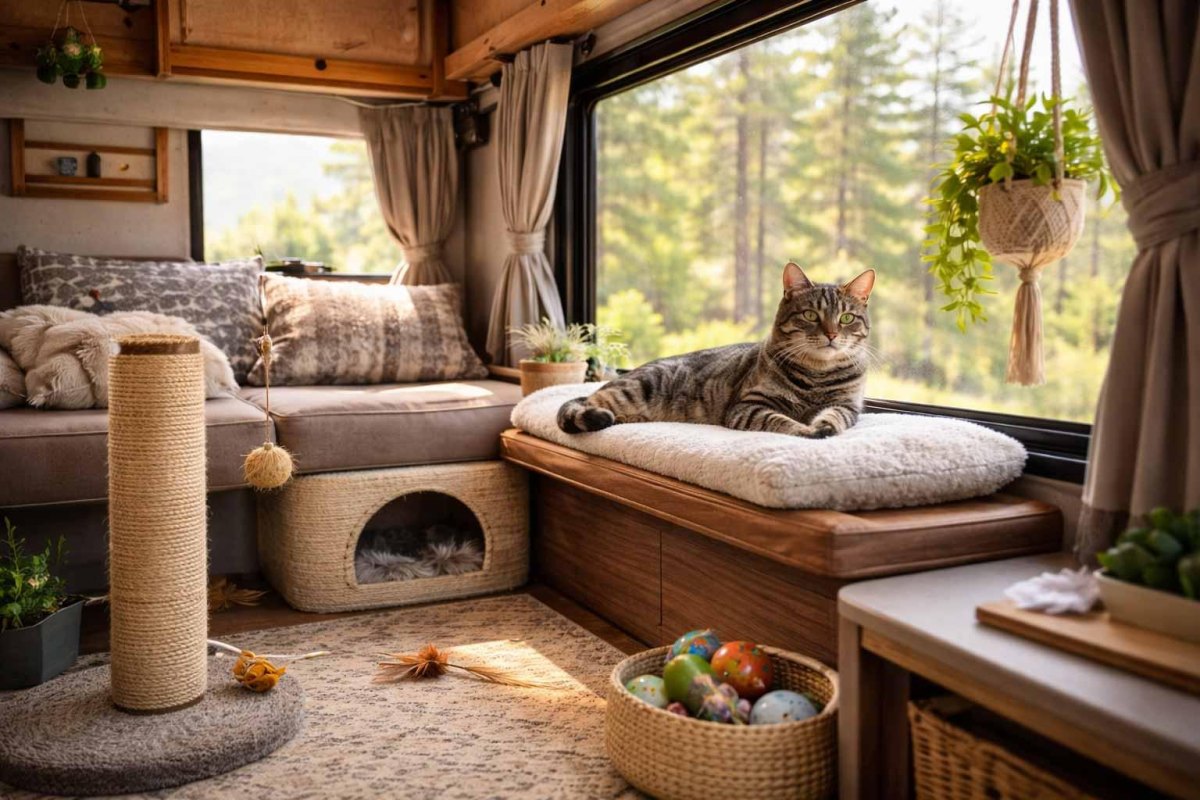
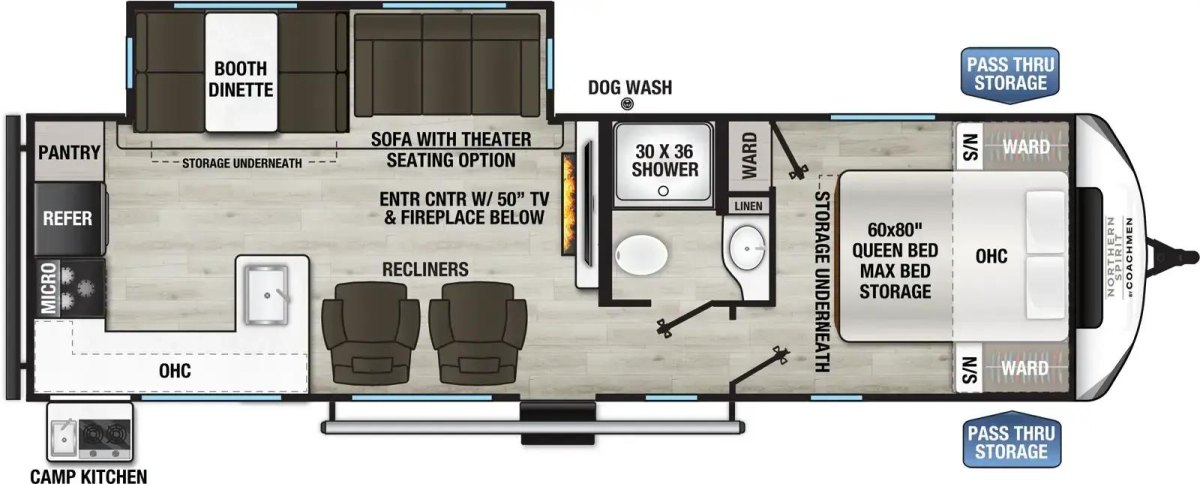
The best RV for traveling with a cat is one that provides a secure, temperature-controlled interior and enough room for essential pet supplies. A motorhome, travel trailer, and fifth wheel can all work, but their layouts create different practical considerations.
Motorhomes offer direct access between the driving area and living space, which can make checking on your cat easier when parked. Travel trailers and fifth wheels generally provide more separation between the towing vehicle and the living area. Your cat should ride in a properly secured carrier inside the tow vehicle, never loose inside a trailer while it is being towed.
Before choosing a rig, check the available floor space for a litter box, food and water stations, a carrier, and a quiet sleeping area. Also consider ventilation, window security, storage for supplies, and whether the air-conditioning system can reliably maintain a safe indoor temperature when parked.
I would prioritize reliable climate control and secure storage over decorative upgrades. A beautiful interior is less useful if there is nowhere safe to put a litter box.
Source: CDC Pet Travel Safety.
Get Your Cat Comfortable With the RV Before Departure
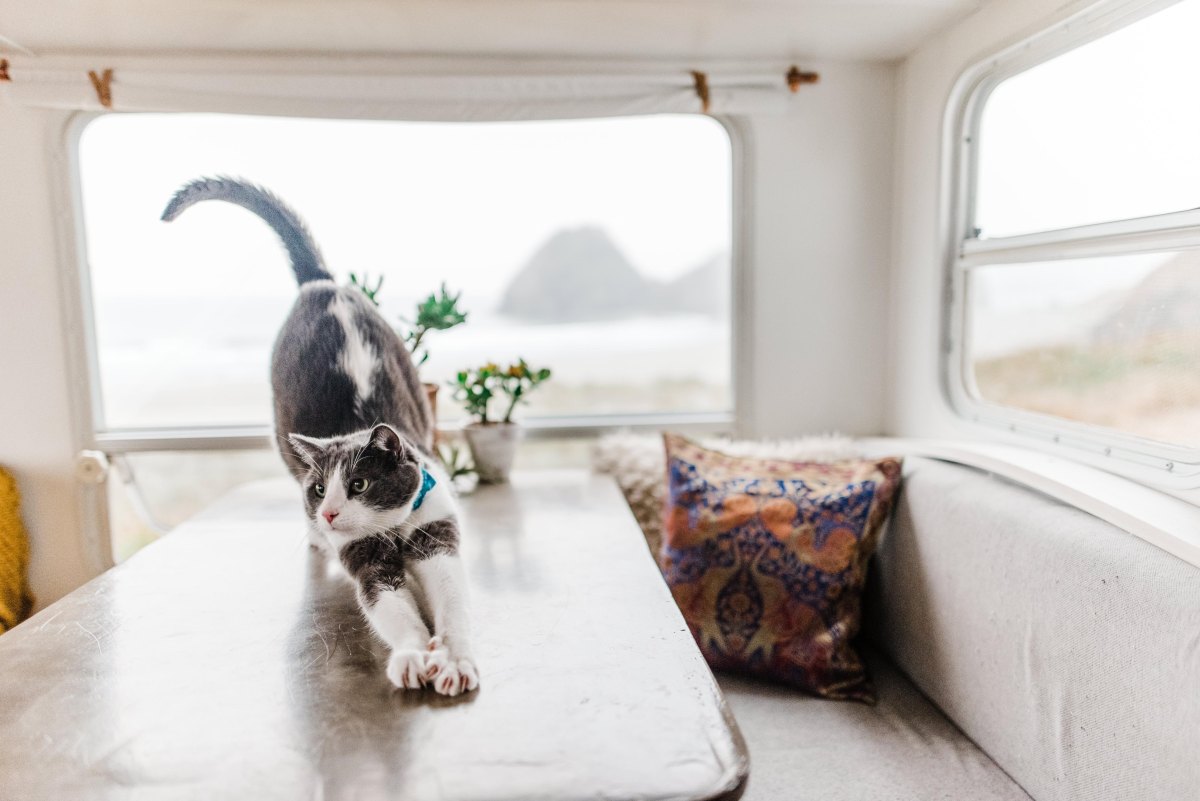
Do not make departure day your cat's first introduction to the RV. An unfamiliar interior combined with engine noise, vibration, and movement can create unnecessary stress. I recommend beginning RV acclimation several weeks before departure, especially for cats that have never traveled by vehicle.
Start by allowing your cat to explore the parked RV while the engine is off. Keep familiar bedding, toys, food, and water available. Let the cat investigate at its own pace rather than carrying it from one unfamiliar space to another.
Once your cat seems comfortable, introduce the sound of the engine and take a few short drives. Gradually increase the journey length as your cat becomes accustomed to the experience. Reward calm behavior with treats and familiar attention.
Watch for excessive vocalization, persistent hiding, panting, or other signs of distress. If travel anxiety remains significant, ask your veterinarian about appropriate management options before the trip.
According to Cats Protection, gradual car introductions and familiar bedding can help cats become more comfortable with travel.
Source: Cats Protection travel guidance.
Pack Essential Cat Travel Supplies
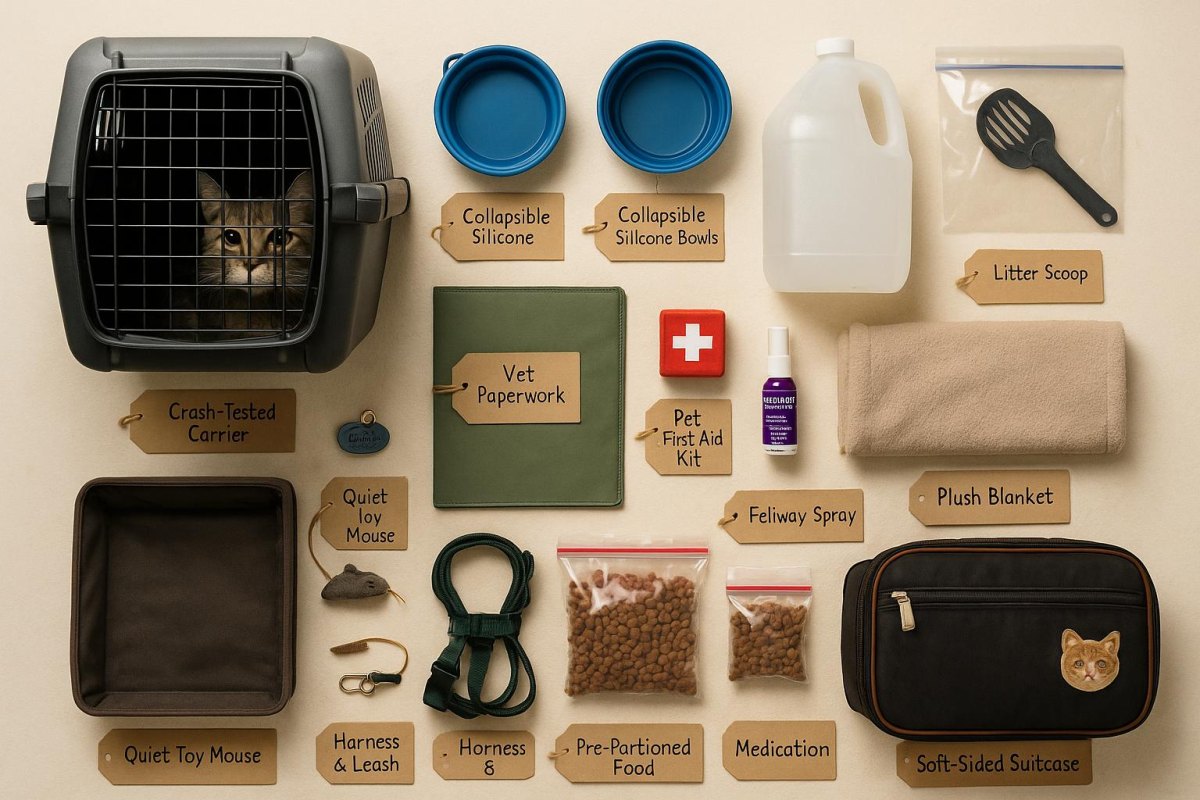
Running out of cat food or litter in an unfamiliar town is an avoidable problem. I recommend preparing a dedicated cat travel supply kit before leaving home. Keep frequently used items accessible instead of burying them beneath camping equipment.
Pack enough familiar food, water, medication, and litter for the planned trip, plus several extra days in case weather, mechanical problems, or road closures change your schedule. Sudden food changes can upset a cat's digestion, so carry the regular brand whenever possible.
- Regular dry and wet cat food
- Fresh drinking water and portable bowls
- Food storage containers and measuring scoop
- Cat carrier and absorbent bedding
- Travel litter box, familiar litter, and scoop
- Waste bags and pet-safe cleaning supplies
- Favorite blanket, toys, and scratching pad
- Harness, leash, collar, and identification tags
- Prescription medications and veterinary records
- Pet first-aid supplies and emergency contact information
Keep an up-to-date photograph of your cat and copies of important medical documents. If you are crossing state or national borders, check the applicable vaccination, identification, and health-document requirements well before departure.
Source: UC Davis Veterinary Medicine cat travel guide and Merck Veterinary Manual pet travel kit.
Choose a Safe and Comfortable Cat Carrier
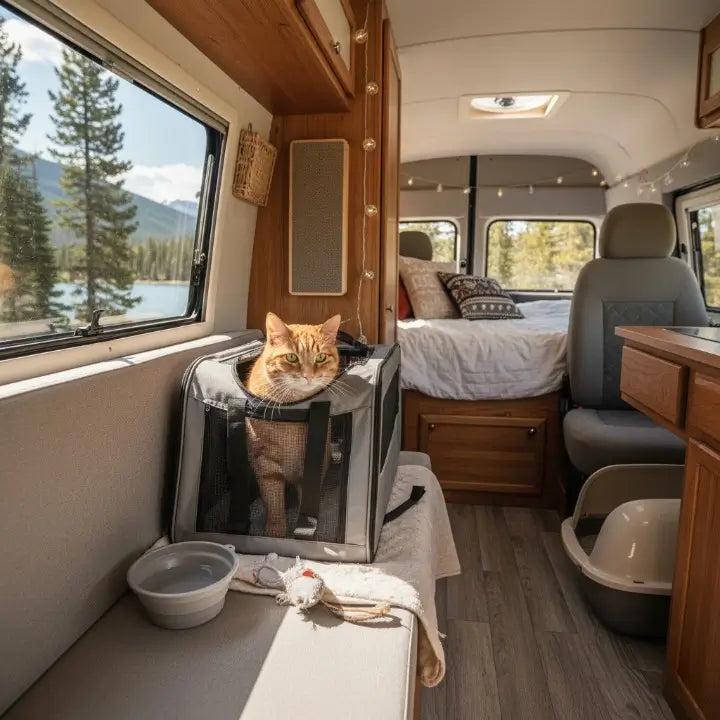
A reliable carrier is essential for every RV trip. It provides a familiar hiding place, makes loading and unloading safer, and prevents your cat from moving around the vehicle while you drive. Choose a sturdy, well-ventilated carrier with secure closures and enough room for your cat to stand, turn around, and lie down comfortably.
Hard-sided carriers are generally practical for road travel because they are easier to clean and maintain their shape. A removable top can also make veterinary examinations less stressful. Check the doors, hinges, handles, and locking mechanisms before every major journey.
Place familiar bedding and an absorbent pad inside. A lightweight towel covering part of the carrier can provide privacy without blocking ventilation.
Carrier positioning matters. The 2025 Feline Veterinary Medical Association guidance recommends securing carriers on the vehicle floor behind the driver or passenger seat. Seat belts should only be used with carriers specifically crash-tested and approved for that purpose.
Important carrier safety
Do not assume that a standard plastic carrier becomes crash-safe simply because it is strapped into a seat. Use a suitable secured position and follow the carrier manufacturer's crash-safety instructions.
Source: FelineVMA 2025 transportation position statement.
Create a Dedicated Space for Your Cat Inside the RV
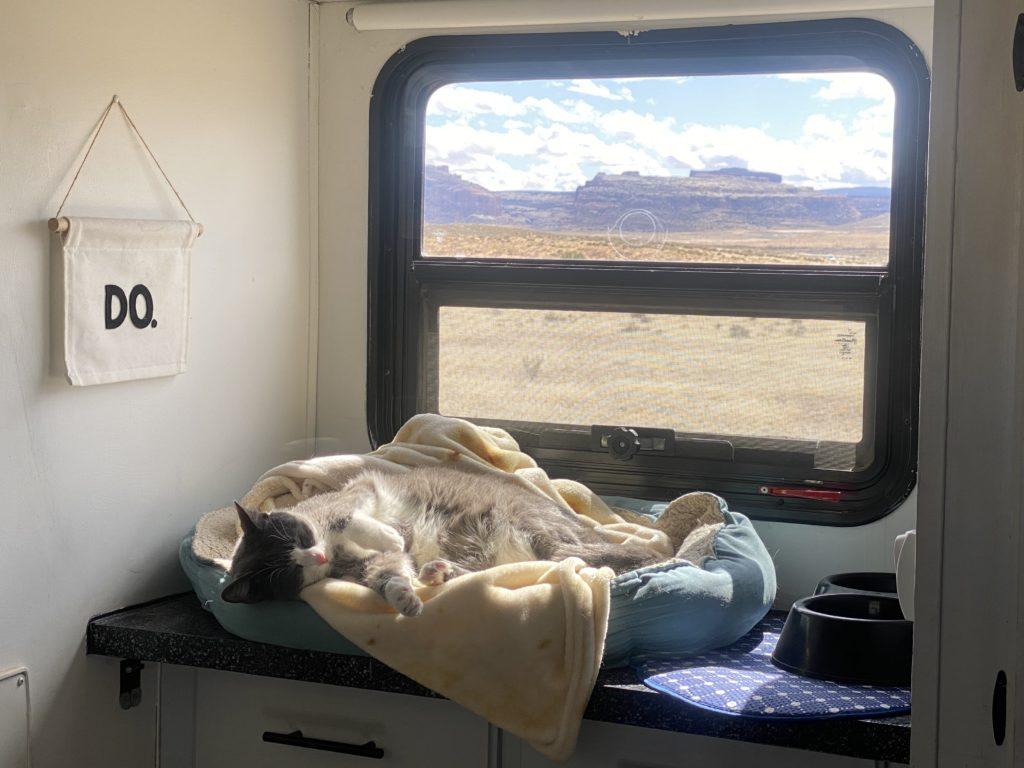
Even a relatively spacious RV can feel cramped when everything belongs to everyone. Cats benefit from having a predictable place where they can sleep, hide, observe their surroundings, and retreat when the vehicle becomes busy. Create a dedicated cat-friendly area before the first overnight stay.
A quiet corner with a washable bed, familiar blanket, scratching surface, and a small hiding box is a good starting point. If the layout allows, provide an elevated resting spot with a secure surface. Cats often appreciate having a place from which they can observe without being disturbed.
Keep food and water away from the litter box. Secure furniture, shelves, and decorative objects so they cannot shift or fall when the RV moves. Check narrow gaps behind appliances, cabinets, and furniture where a frightened cat might become trapped.
Do not force your cat to use its new sleeping area immediately. Leave the carrier open when the RV is stationary and allow the cat to choose where it feels comfortable.
Veterinary environmental guidelines emphasize the importance of hiding opportunities and familiar resources in reducing feline stress.
Source: ISFM and AAFP Cat-Friendly Veterinary Environment Guidelines.
Keep Your Cat Secure While the RV Is Moving
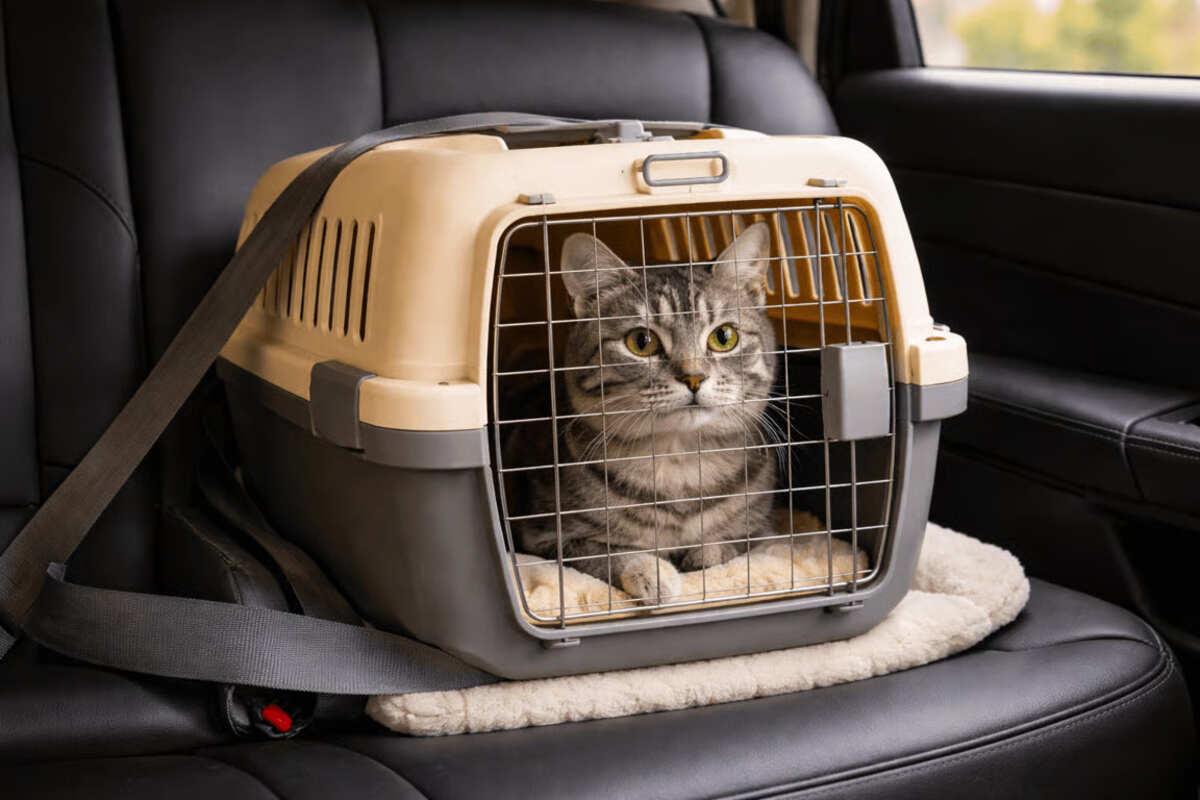
This is one rule I would not compromise on: your cat must be restrained whenever the vehicle is moving. An unsecured cat can become a distraction, interfere with the driver, or suffer serious injuries during sudden braking or a collision.
In a motorhome, secure the cat in its carrier in an appropriate position within the vehicle's driving compartment. In a travel trailer or fifth wheel, transport the cat in the tow vehicle, not inside the trailer. The trailer is not a safe substitute for a passenger compartment.
Never allow your cat to sit on the dashboard, wander between seats, or hide beneath the driver's pedals. Keep the carrier away from direct sunlight and heating or cooling vents that blow directly onto the cat.
At rest stops, close vehicle doors and secure windows before opening the carrier. Never let the cat roam freely while people enter or exit the vehicle.
Avoid this common mistake
Do not open a carrier beside an open vehicle door because your cat appears calm. A frightened cat can escape in seconds, even in a familiar parking area.
Source: FelineVMA 2025 vehicle transportation recommendations.
Maintain Your Cat's Feeding and Hydration Routine
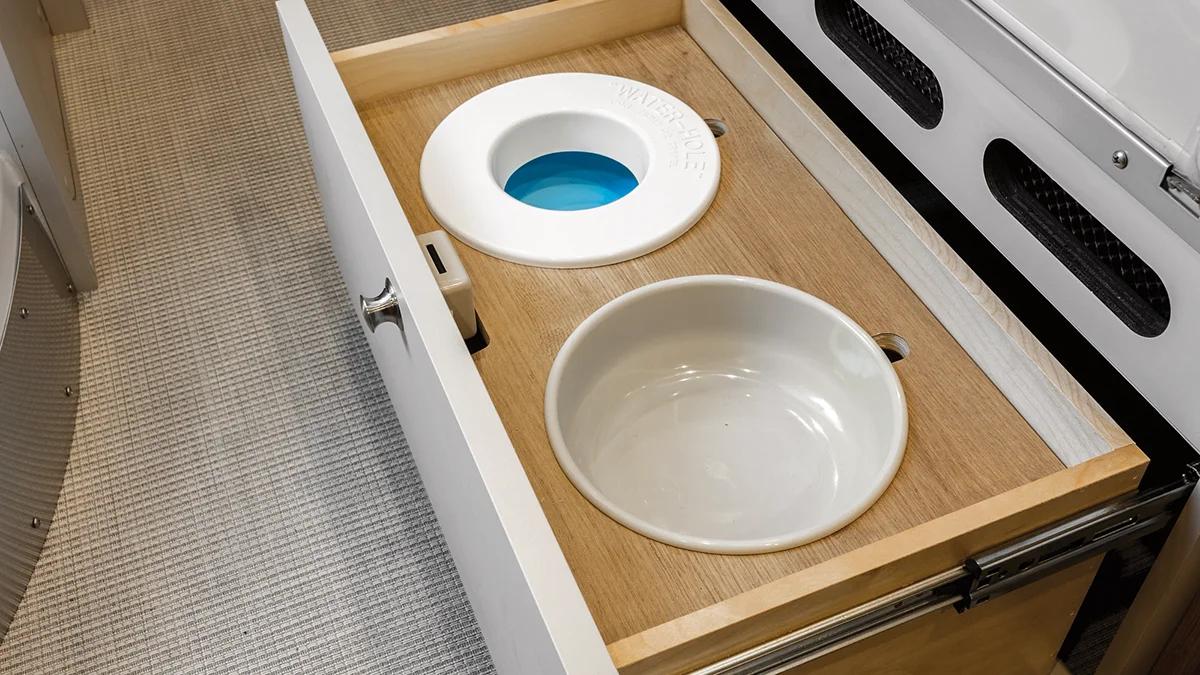
Travel changes the scenery, but your cat's basic nutritional needs remain the same. Maintaining familiar meal times and food choices helps establish a predictable daily routine and can reduce unnecessary digestive upset.
Measure regular portions rather than allowing unlimited access to food if that is not your cat's usual feeding arrangement. Carry enough of its normal food for the entire trip, including a reserve supply. Sudden changes in brands, flavors, or feeding schedules are best avoided unless your veterinarian recommends them.
Fresh drinking water should always be available while the RV is parked. Use a stable, spill-resistant bowl and place it somewhere away from the litter box. During driving intervals, offer water at safe stops and provide a comfortable opportunity to drink once the vehicle is stationary.
For cats prone to motion sickness, discuss meal timing with your veterinarian. There is no single fasting schedule suitable for every cat, particularly kittens, senior cats, and animals with medical conditions.
Check your cat's appetite, drinking habits, and energy level every day. Changes in eating or drinking can be an early indication that something is wrong, rather than simply a reaction to the new surroundings.
Source: American Veterinary Medical Association pet travel guidance.
Set Up a Clean and Accessible Litter Box
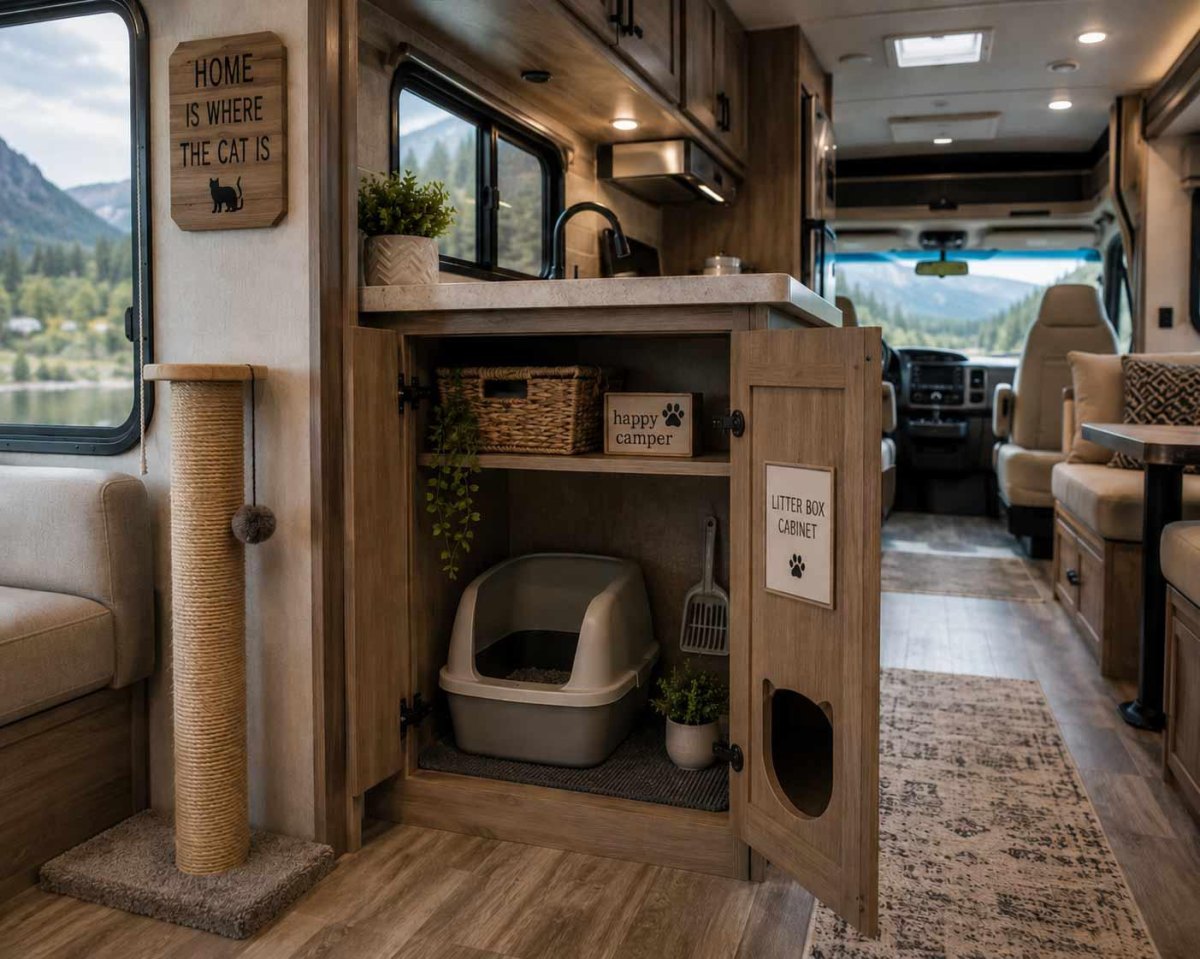
Litter box placement can make or break the practicality of an RV interior. Cats need a familiar, accessible toilet area, while RV owners need a setup that is easy to clean and does not interfere with everyday movement. A compact but appropriately sized litter box is usually the most practical option.
Measure the available floor space before buying a travel box. A plastic storage tray or portable litter box may work if it is large enough for your cat to use comfortably. Avoid choosing a box that is so small that your cat cannot turn around or dig normally.
Use the same litter your cat already knows. Place the box in a quiet location with reasonable privacy and ventilation. Keep it away from food, water, and busy entryways. A secure, nonslip mat underneath can help contain scattered litter.
- Choose a location. Find a stable corner that remains accessible when the RV is parked.
- Add familiar litter. Avoid experimenting with new litter during the first few travel days.
- Scoop regularly. Remove waste at least daily and more often if needed.
- Store waste properly. Use sealed bags and dispose of litter only in designated waste facilities.
- Clean the box. Wash it as needed with a pet-safe cleaning product.
Never dump used litter or cat waste onto campsites, public land, or natural ground. Follow local campground waste-disposal rules.
Source: VCA road trips and cat travel guidance and ISFM and AAFP feline environmental guidelines.
Plan Pet-Friendly RV Stops and Destinations
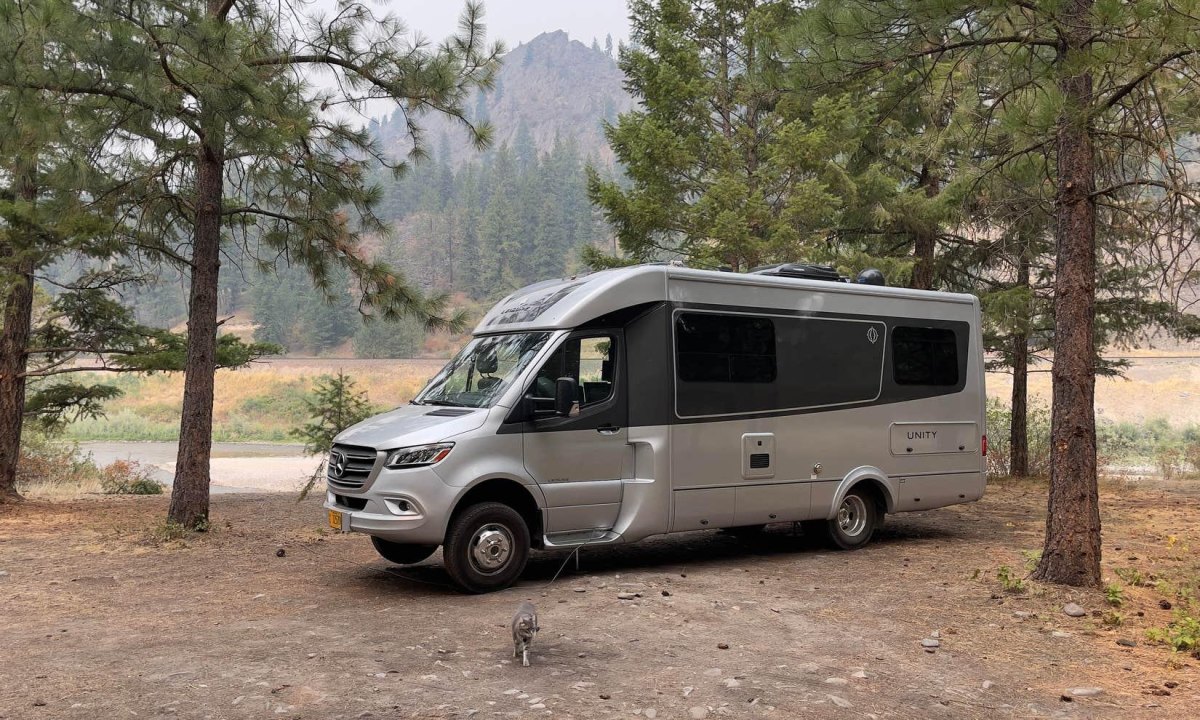
A campsite that welcomes dogs does not automatically welcome cats under the same conditions. Before booking, check the campground's current pet policy, including leash requirements, designated pet areas, indoor restrictions, and any additional fees.
National parks, state parks, private RV resorts, and dispersed camping areas can have very different rules. Some public lands restrict pets on particular trails, beaches, or protected areas. Check the specific managing agency's current regulations rather than relying on an old travel blog or campground review.
Plan travel days around your cat's tolerance for driving. Regular safe stops give you an opportunity to check the carrier, offer water, and inspect the animal's condition. Cats do not necessarily need to leave the vehicle at every stop, especially if the surroundings are noisy or unsecured.
For longer journeys, identify veterinary clinics and emergency animal hospitals along your route. I also recommend choosing overnight stops with reliable electrical hookups when dependable air-conditioning or heating is necessary for your cat's safety.
- Private campgrounds: Confirm pet rules and additional charges before booking.
- State parks: Review individual campground and trail restrictions.
- National parks: Check pet-accessible areas and restrictions through the National Park Service.
- Dispersed camping: Follow the relevant land-management agency's pet, waste, fire, and stay-limit rules.
Source: National Park Service pet guidance.
Protect Your Cat From Heat and Cold
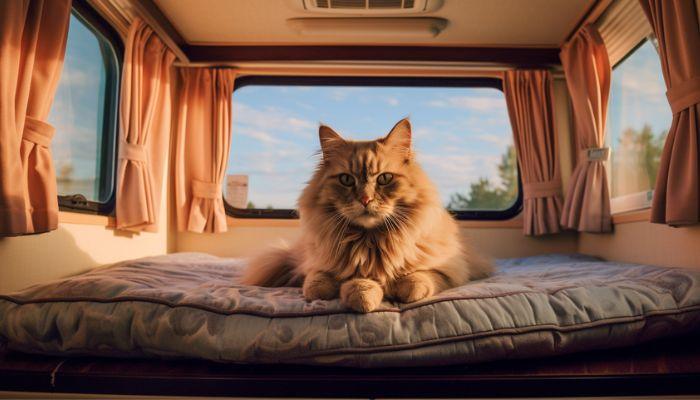
Temperature management is one of the most important parts of RV cat travel. An RV can become dangerously hot or cold when parked, and climate-control equipment is not guaranteed to operate continuously. Never assume the interior will remain safe simply because the air-conditioning or heating system was working when you left.
Hot weather requires particular attention. Keep the RV shaded where possible, use suitable ventilation, and monitor the interior temperature with a device that can send alerts. However, a temperature monitor is not a replacement for a person who can respond immediately when conditions change.
Air-conditioning may depend on campground electrical service, generator operation, battery capacity, or inverter configuration. A power interruption can turn a comfortable RV into an unsafe environment. Have a realistic backup plan and do not leave your cat unattended when a safe indoor temperature cannot be maintained reliably.
Cold weather creates a different set of problems. Check for drafts, maintain safe heating, and provide warm bedding. Never use a propane cooktop, oven, or unvented heater as cabin heating equipment. Keep carbon monoxide detectors operational and within their replacement dates. Never run a generator near an RV window, vent, air intake, or beneath the vehicle.
Do not leave temperature safety to chance
The CDC advises never leaving pets in parked vehicles. An RV is not exempt from the same heat risks. If you cannot guarantee a safe environment and an immediate response to equipment failure, take your cat with you in a secure carrier or arrange appropriate supervision.
Source: CDC Heat and Pets guidance and CDC Pet Travel Safety.
Keep Your Cat Entertained During Long Road Trips
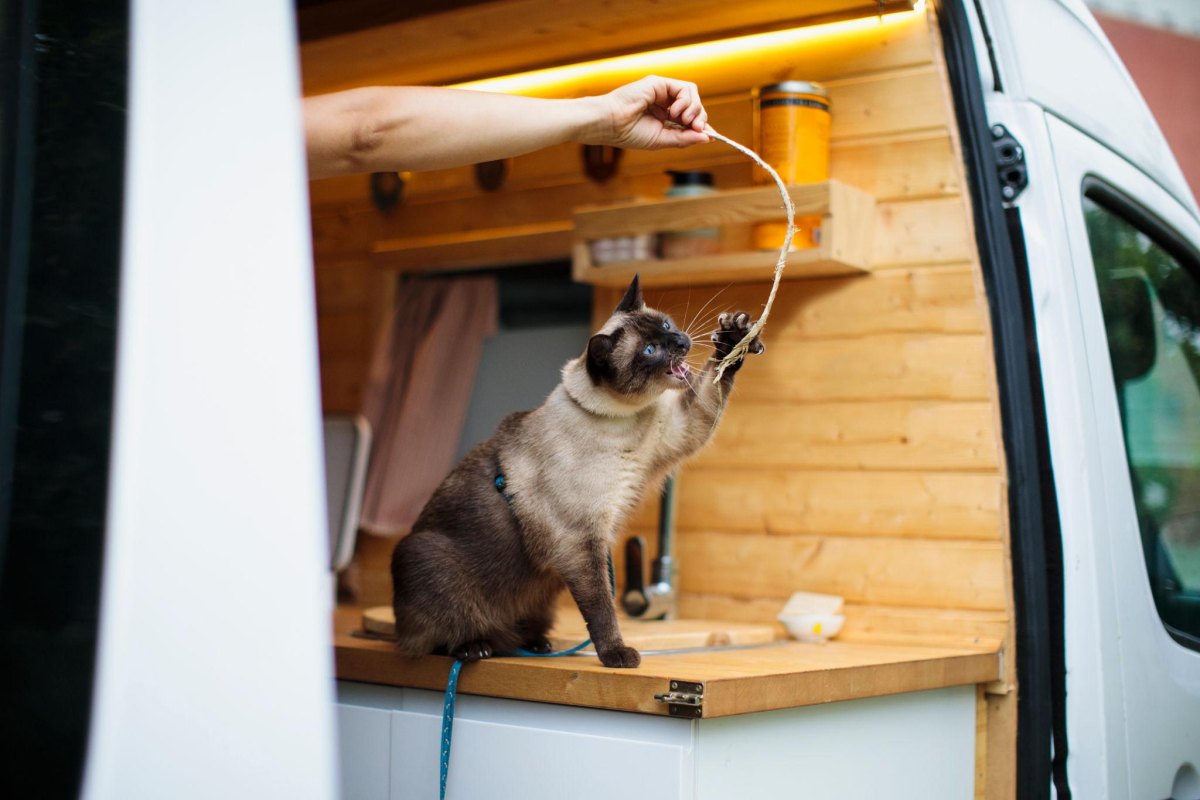
Travel days can become repetitive, especially when your cat spends several hours inside a carrier or resting area. Once the RV is parked, provide opportunities for safe play and mental stimulation so your cat can maintain familiar behaviors.
Pack a small selection of favorite toys rather than filling the RV with new equipment. Lightweight balls, puzzle feeders, soft toys, and a portable scratching pad can provide useful enrichment without taking up much storage space.
Schedule short play sessions during the morning and evening, depending on your cat's usual activity pattern. Interactive wand toys are useful when supervised, but put them away afterward. String, ribbon, loose feathers, and small detachable pieces can create choking or ingestion hazards if left unattended.
A secure window perch can provide visual stimulation while the RV is parked. Check the window screen and locking mechanism first. A screen alone is not a dependable escape barrier, particularly if your cat pushes against it.
Rotating a few toys every couple of days can help maintain interest without requiring additional storage. Simple enrichment is often enough; you do not need expensive electronic gadgets to keep a cat occupied.
Source: Cornell Feline Health Center safe toys and gifts.
Prevent Your Cat From Escaping at Campsites
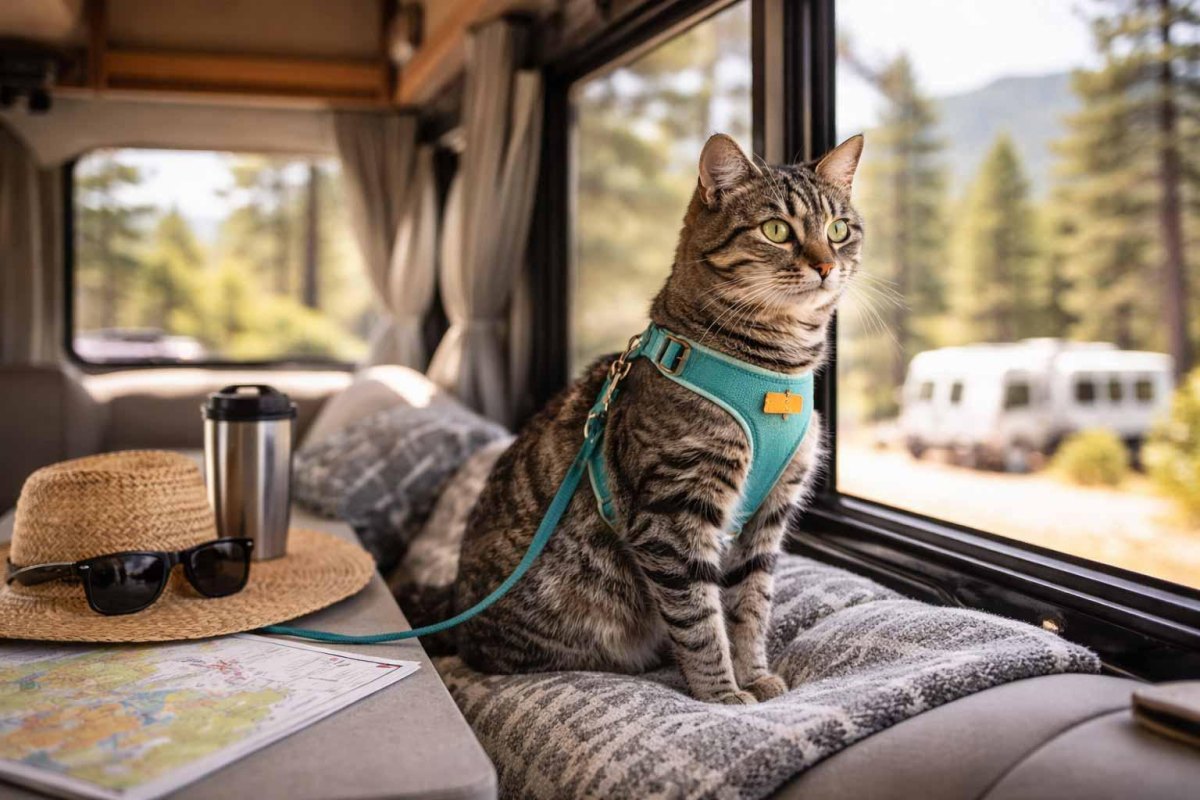
An unfamiliar campsite can be full of tempting smells, wildlife, noises, and hiding places. Even an indoor cat that has never shown interest in escaping may bolt when startled by a passing dog, vehicle, or neighboring camper. Escape prevention needs to be built into your campsite routine.
Keep your cat indoors unless you have prepared a controlled outdoor setup. A properly fitted harness and leash can provide supervised exploration for cats that have been trained to accept them. Introduce the harness gradually at home, and check that your cat cannot back out of it.
Never tie a cat to an RV step or campsite furniture and leave it unattended. A sudden movement or tangled leash can cause injury. A secure, enclosed outdoor pet tent can be another option, provided it is anchored, ventilated, and supervised.
Before opening the RV door, know where your cat is. A simple household routine helps: locate the cat, secure it away from the doorway, and then allow people to enter or exit. Check window screens, roof vents, and exterior access points regularly.
- Keep your cat's microchip registration current.
- Use a collar with readable identification where appropriate.
- Keep a recent photograph on your phone.
- Check doors, windows, and screens before opening them.
- Use a secure harness only after proper training.
- Never leave a cat unattended outdoors.
The CDC recommends microchipping pets and keeping contact information updated. These precautions are particularly important when traveling far from home.
Source: CDC Pet Travel Safety and RSPCA cat adjustment and security guidance.
Prepare for Veterinary Emergencies on the Road
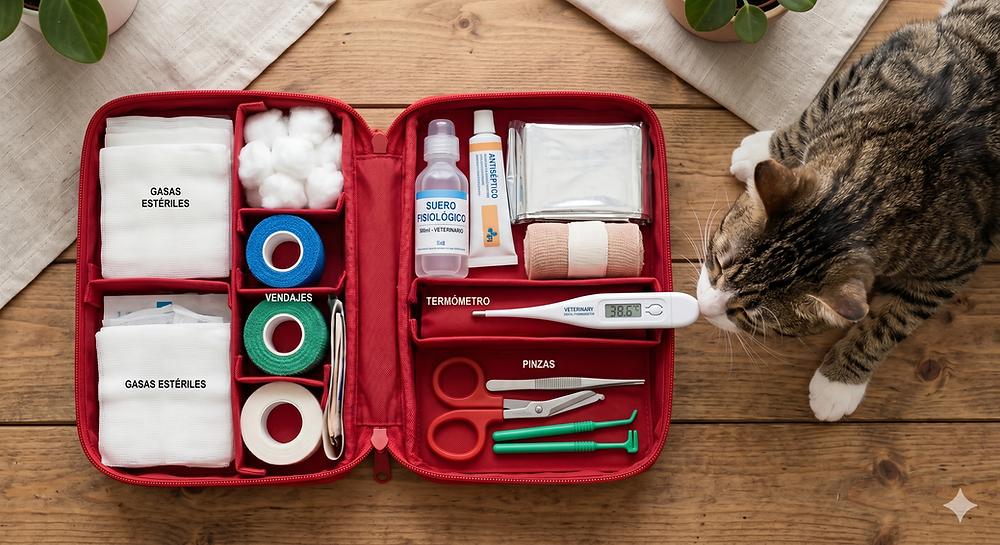
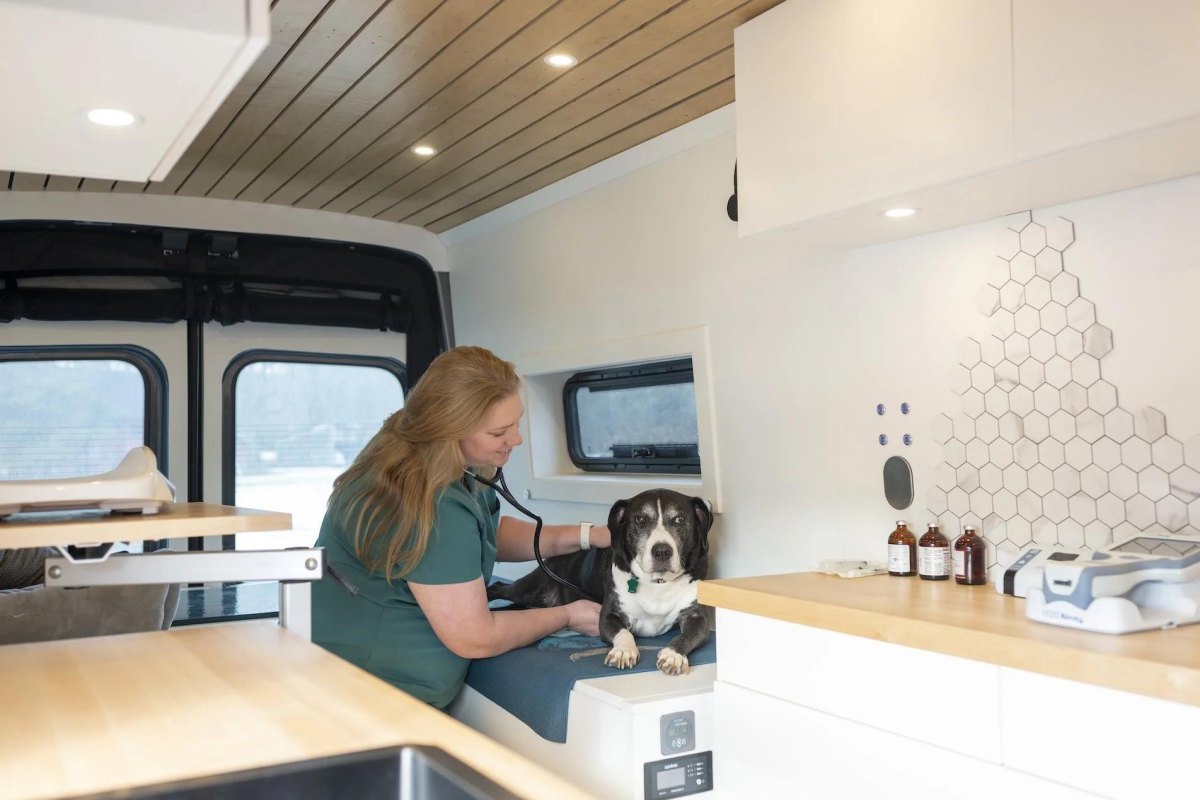
Veterinary care is not always close to a remote campground. A minor problem can become more difficult to manage when the nearest clinic is several towns away. I recommend preparing a pet emergency plan before leaving home, rather than searching for help after something happens.
Start with a routine veterinary examination before an extended journey. Confirm that vaccinations, parasite prevention, and prescribed medications are current. Ask whether your cat has any health conditions that could affect travel or require special monitoring.
Keep a digital and printed copy of vaccination records, medical history, medication instructions, your regular veterinarian's contact details, and recent photographs. Identify at least one emergency veterinary hospital near your overnight destination and another along longer travel routes.
A basic pet first-aid kit should include gauze, non-stick dressings, disposable gloves, saline wound-cleaning solution, a digital thermometer, and any veterinarian-approved supplies specific to your cat. Do not give human painkillers or other medication unless a veterinarian specifically directs you to do so.
Make emergency information easy to find
Store the nearest emergency clinic's address and phone number in your phone and keep a printed copy with your cat's medical documents. Include the number for your regular veterinarian so important medical history can be shared quickly.
For international travel, check destination-specific requirements well in advance. Microchip standards, rabies vaccination documentation, health certificates, and entry procedures can vary by country.
Source: UC Davis cat travel recommendations and Merck Veterinary Manual pet travel kit.
Help Your Cat Adjust to New Campsites and Surroundings
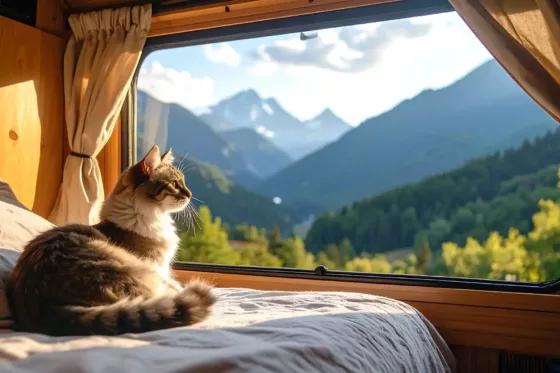
Arriving at a new campsite does not mean your cat is immediately ready to explore. New smells, unfamiliar sounds, neighboring animals, and changing light conditions can all make an otherwise confident cat cautious. Give your pet time to settle before introducing additional changes.
When you arrive, keep the cat secured in its carrier while you park, level the RV, and complete the initial setup. Check that doors and windows are closed before allowing the cat out. Start with a familiar, quiet area inside the RV containing its bed, water, food, litter box, and favorite hiding place.
Leave the carrier available as a retreat. Avoid pulling a hiding cat out to encourage exploration. Instead, let the animal approach new spaces voluntarily. Some cats become comfortable within an hour, while others need much longer.
Keep the first evening relatively quiet. Avoid immediately introducing visitors, unfamiliar pets, or outdoor walks. Once your cat appears relaxed, allow supervised exploration of the rest of the parked RV.
Watch for prolonged hiding, changes in appetite, unusual toileting behavior, excessive grooming, or persistent distress. If these signs continue or your cat appears unwell, contact a veterinarian rather than assuming the behavior is simply travel anxiety.
Familiar scents, gradual introductions, and access to a safe hiding place are recommended in feline adjustment guidance.
Source: RSPCA cat adjustment guidance and Cats Protection travel advice.
A good campsite routine is simple: secure the RV, establish your cat's familiar space, check food and water, and let the animal decide when it is ready to investigate the new surroundings.
More Pinterest Visuals



 RV Maintenance & Care17 Essential RV Winter Storage Tips to Prevent Cold-Weather Damage
 RV Pet Travel11 RV Cat Tree Ideas That Make Small Spaces More Cat-Friendly
 Camping Gear & Planning15 RV Must-Haves for Beginners to Camp Safely and Comfortably
 Camping Recipes18 Easy RV Camping Snacks Ideas for Road Trips and Campfire Nights